


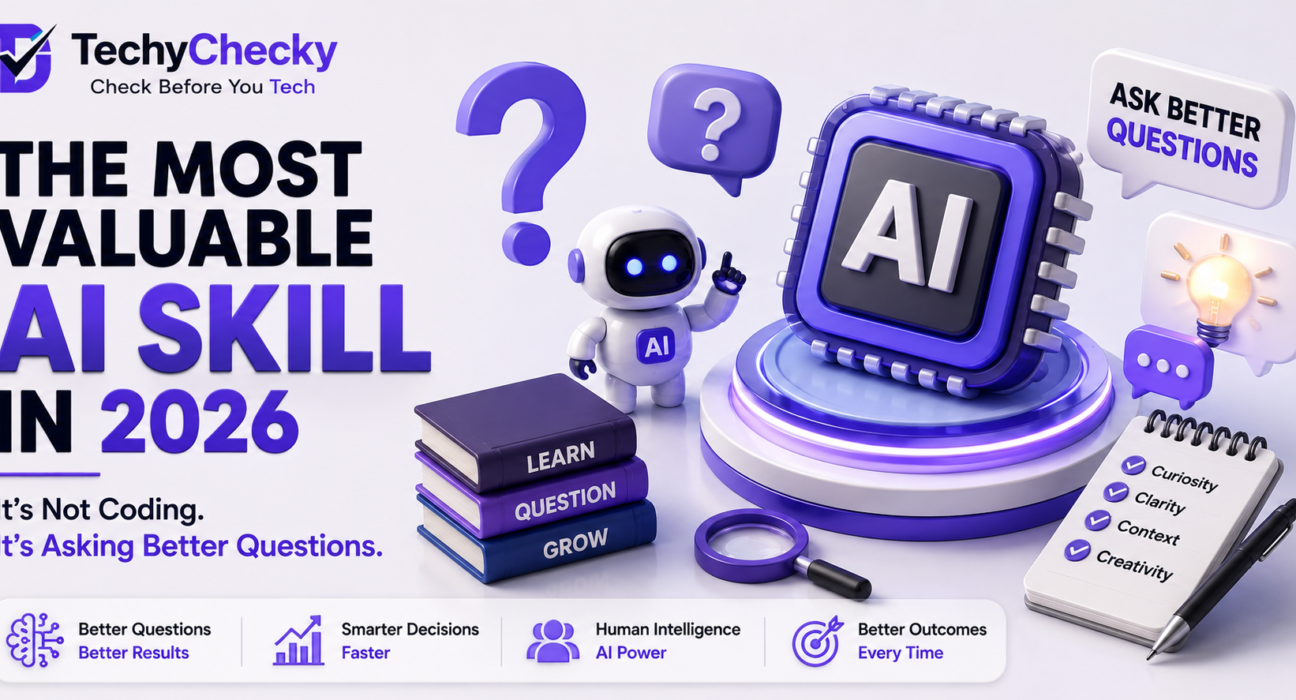
For years, technology careers were associated with one skill above all others.
Coding.
If you wanted to work with technology, build software, or participate in the digital economy, learning programming languages was often considered essential.
Artificial Intelligence is beginning to change that assumption.
While technical skills remain valuable, a new reality is emerging. The people getting the most value from AI are not always the best programmers. In many cases, they are the people who know how to ask the right questions.
This shift is transforming the way individuals and businesses approach technology.
The Rise of AI Assistants
Modern AI tools can write reports, summarize research, generate marketing ideas, analyze data, create images, draft emails, and assist with countless daily tasks.
Yet the quality of the output often depends on one thing.
The quality of the input.
Ask a vague question and you may receive a vague answer.
Ask a detailed and thoughtful question and the results can be remarkably useful.
This has created an entirely new skill that many professionals are still learning.
The ability to communicate effectively with AI.
Why Questioning Matters
Think about the difference between asking:
“Tell me about marketing.”
and
“What are five affordable marketing strategies a local restaurant can use to increase repeat customers within the next three months?”
Both questions involve marketing.
Only one provides enough context to generate meaningful insights.
The same principle applies across industries.
Lawyers, marketers, consultants, teachers, business owners, and students are all discovering that the quality of their prompts often determines the quality of their results.
In many situations, asking better questions has become more valuable than having technical expertise.
AI Rewards Curiosity
One of the most interesting aspects of Artificial Intelligence is how it rewards curiosity.
People who experiment tend to learn faster.
They ask follow up questions.
They explore different perspectives.
They challenge assumptions.
Instead of treating AI as a search engine, they treat it as a collaborative tool.
This mindset often produces better outcomes.
The technology becomes more useful when users actively engage with it rather than passively consuming information.
Businesses Are Learning the Same Lesson
Companies investing in AI quickly realize that software alone is not enough.
The real advantage comes from how employees use it.
Organizations that encourage critical thinking, creativity, and problem solving often achieve stronger results than those that simply deploy new tools.
Artificial Intelligence can generate ideas.
Humans still decide which ideas are worth pursuing.
That distinction remains important.
The Human Advantage
Despite rapid advances in AI, there are certain qualities that remain uniquely human.
Judgment.
Creativity.
Empathy.
Context.
Ethics.
Strategic thinking.
AI can provide information.
Humans provide meaning.
The future workplace is unlikely to be a competition between people and machines.
It is more likely to be a partnership between human intelligence and artificial intelligence.
The professionals who understand both sides will have a significant advantage.
What This Means for Students
Students often ask whether they should learn coding or learn AI.
The answer is not necessarily one or the other.
The most valuable skill may be learning how to think clearly.
Technology changes quickly.
Programming languages evolve.
Software platforms come and go.
The ability to analyze problems, ask intelligent questions, and evaluate information remains valuable regardless of technological trends.
These skills become even more important in an AI driven world.
Looking Ahead
Artificial Intelligence will continue to become more powerful.
New tools will emerge.
Capabilities will expand.
Workplaces will evolve.
Yet one thing appears increasingly clear.
The people who thrive will not simply be those who have access to AI.
They will be the people who know how to use it effectively.
And effective use often begins with a simple skill.
Knowing what questions to ask.
At TechyChecky.com, we believe technology is most powerful when it helps people think better, learn faster, and make smarter decisions.
Check Before You Tech.