



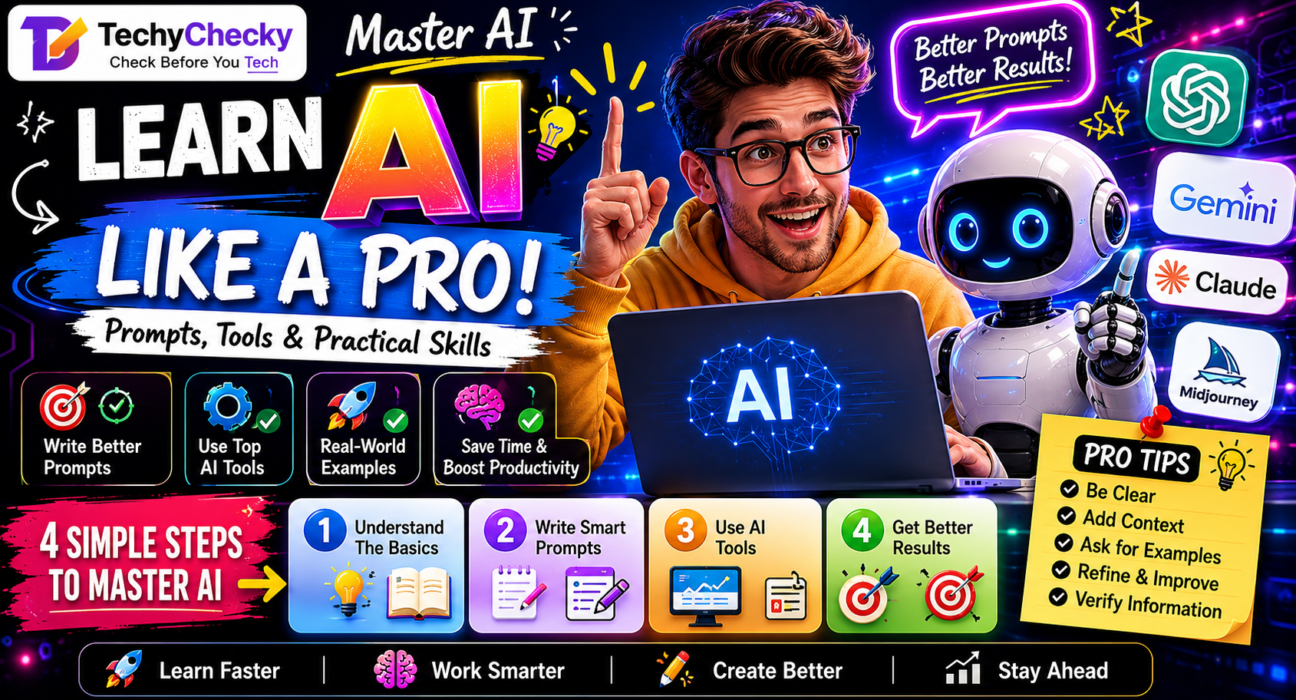
Artificial Intelligence is everywhere.
People use it to write emails, generate images, create business plans, analyze data, build websites, and even prepare for job interviews.
Yet despite having access to powerful AI tools, many users fail to get useful results.
The reason is surprisingly simple.
Most people don’t know how to communicate with AI effectively.
Learning how to use AI is quickly becoming a valuable skill, much like learning how to use search engines or spreadsheets in the past.
This guide will help you understand the basics and show you how to get better results from AI tools.
What Is an AI Prompt?
A prompt is simply the instruction you give to an AI system.
Think of it as a conversation.
The quality of your prompt often determines the quality of the response.
For example:
Poor Prompt:
“Write about marketing.”
Better Prompt:
“Write a beginner-friendly 800-word article explaining email marketing for small business owners. Use simple language and real-world examples.”
Notice the difference.
The second prompt gives context, audience, and expectations.
As a result, the AI can produce a much better answer.
The Formula for Better Prompts
A simple framework used by many professionals is:
Role + Task + Context + Output Format
Example:
“You are a digital marketing expert. Explain email marketing to a small business owner who has no prior experience. Use simple language and provide five practical tips in a numbered list.”
This structure dramatically improves results.
How Businesses Use AI
Companies around the world are using AI to save time and improve productivity.
Common business applications include:
Content Creation
- Blog articles
- Social media posts
- Product descriptions
- Website content
Customer Support
- Frequently asked questions
- Chatbot responses
- Email replies
Marketing
- Campaign planning
- Audience research
- Advertisement ideas
Data Analysis
- Reports
- Trend identification
- Business insights
AI does not replace expertise, but it often speeds up routine work.
Popular AI Tools Beginners Should Know
ChatGPT
Useful for writing, brainstorming, research, learning, coding assistance, and problem solving.
Gemini
Useful for research, productivity, and integration with Google’s ecosystem.
Claude
Popular for long-form writing, document analysis, and detailed explanations.
Midjourney
Specializes in AI-generated artwork and creative visuals.
Canva AI
Helps create presentations, graphics, and marketing materials.
Different tools serve different purposes.
Learning when to use each tool is just as important as learning how to use them.
Five Prompt Examples You Can Copy Today
Create a Blog Article
“Act as a technology journalist and write a 1,000-word article about cybersecurity trends for beginners. Use a professional but easy-to-understand tone.”
Write a Marketing Email
“Act as an email marketing specialist. Create a promotional email for a small ecommerce store launching a new product.”
Learn a New Skill
“Explain cloud computing as if you were teaching a 12-year-old student. Use real-world examples.”
Business Research
“Act as a business consultant. Analyze the advantages and disadvantages of starting an online service business.”
Social Media Content
“Create five engaging LinkedIn post ideas about Artificial Intelligence for business owners.”
Common Mistakes Beginners Make
Being Too Vague
The less information you provide, the less useful the output often becomes.
Trusting Everything
AI can occasionally make mistakes.
Always verify important information.
Using One Prompt Only
Professionals rarely stop after one prompt.
They refine, improve, and ask follow-up questions.
Ignoring Context
The more context you provide, the better the results generally become.
Advanced Prompting Techniques
Once you’re comfortable with basic prompts, try these methods:
Ask AI to Act as an Expert
Example:
“Act as a cybersecurity consultant.”
Define the Audience
Example:
“Explain this to a startup founder.”
Specify the Format
Example:
“Provide the answer in a table.”
Request Examples
Example:
“Give three real-world examples.”
These techniques can dramatically improve output quality.
The Future of AI Skills
Many people believe coding will be the most valuable technology skill.
Coding remains important.
However, knowing how to communicate effectively with AI is rapidly becoming a competitive advantage.
Businesses increasingly value employees who can use AI to solve problems, improve productivity, and generate ideas.
Learning how to write effective prompts may soon become a standard workplace skill.
Final Thoughts
Artificial Intelligence is not magic.
It is a tool.
Like any tool, its value depends on how you use it.
The people who get the best results are usually not the ones with the most advanced software.
They are the ones who know how to ask better questions.
Start simple.
Experiment often.
Refine your prompts.
Stay curious.
The more you practice, the more valuable AI becomes.
At TechyChecky.com, our goal is to help readers understand technology in practical ways that create real value.
Check Before You Tech.
#AITools #PromptEngineering #Productivity