


Few topics create more debate than Artificial Intelligence and jobs.
Every week there seems to be a new headline about AI writing content, creating images, answering customer questions, or helping businesses automate tasks. As these tools become more powerful, many people are asking the same question.
Will Artificial Intelligence eventually replace human workers?
It is a reasonable concern.
Whenever a major technology changes the way we work, people naturally worry about their future. We saw it during the Industrial Revolution. We saw it when computers entered offices. We saw it when the internet transformed entire industries.
Now we are seeing it again with AI.
The reality, however, is more complex than the headlines suggest.
Why People Fear AI
Artificial Intelligence can already perform many tasks that once required human effort.
AI can:
- Write reports
- Analyze data
- Answer customer questions
- Generate images
- Summarize information
- Translate languages
When people see these capabilities, it is easy to assume that machines will eventually take over entire professions.
But history teaches us an important lesson.
Technology rarely eliminates all jobs.
Instead, it changes jobs.
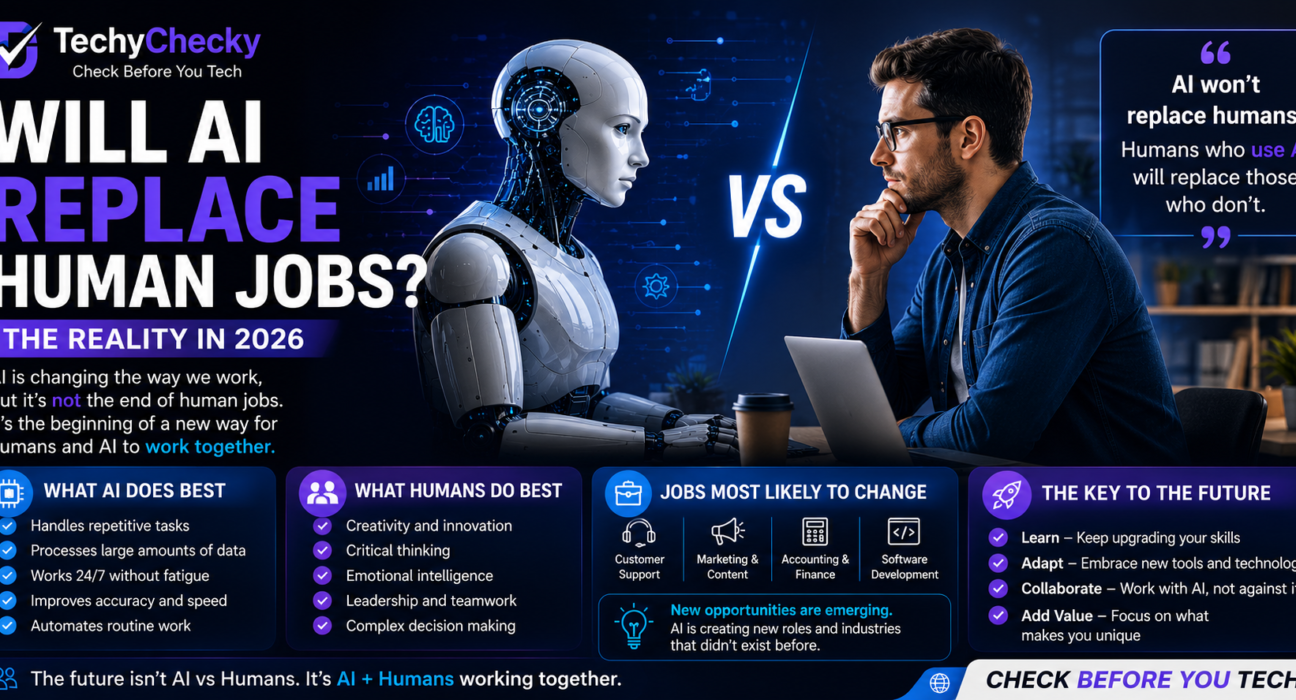
What AI Does Best
Artificial Intelligence is particularly effective at handling repetitive and predictable tasks.
For example:
- Processing large amounts of data
- Sorting information
- Generating reports
- Identifying patterns
- Performing routine administrative work
These are tasks that computers can often complete faster and more efficiently than humans.
Businesses are using AI because it can save time and reduce costs.
That trend is likely to continue.
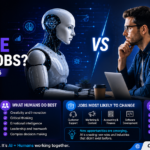
What Humans Still Do Better
Despite all the progress in AI, there are many areas where humans continue to have a significant advantage.
Humans excel at:
- Creativity
- Critical thinking
- Emotional intelligence
- Leadership
- Relationship building
- Strategic decision making
A chatbot may answer customer questions.
A human can build trust with an upset customer.
An AI tool may generate ideas.
A human can evaluate those ideas and make complex decisions.
Technology can support people, but it does not fully replace human judgment.
Jobs Most Likely to Change
Some professions are already experiencing significant transformation.
Examples include:
Customer Support
AI can answer routine questions, but human agents still handle complex situations.
Marketing
AI helps generate content and analyze data, while marketers focus on strategy and creativity.
Accounting
Automation handles repetitive calculations, allowing accountants to focus on advisory services.
Software Development
AI can assist with coding, but human developers remain responsible for architecture, innovation, and problem solving.
Many jobs are evolving rather than disappearing.
New Opportunities Are Emerging
One aspect often overlooked in the AI debate is the creation of new jobs.
Every major technological advancement creates opportunities that previously did not exist.
Today we are seeing growing demand for:
- AI Specialists
- Prompt Engineers
- AI Trainers
- Data Analysts
- AI Consultants
- Cybersecurity Professionals
- Technology Strategists
Five years ago, many of these roles barely existed.
The AI economy is creating entirely new career paths.
The Future Belongs to Adaptable People
The biggest risk is not Artificial Intelligence itself.
The biggest risk is refusing to adapt.
Professionals who continuously learn new skills will remain valuable regardless of technological changes.
The workplace is changing faster than ever.
People who embrace technology often discover new opportunities rather than new threats.
Learning how to work alongside AI may become one of the most important career skills of the next decade.
Should Students Be Worried?
Students entering the workforce often wonder whether AI will limit their career options.
The answer is no.
In fact, understanding AI may become a major competitive advantage.
Future employers will increasingly look for candidates who know how to use technology effectively.
Students who develop both technical skills and human skills will be in a strong position.
The combination of AI knowledge and human creativity will be highly valuable.
The Real Question We Should Ask
Perhaps the wrong question is:
“Will AI replace humans?”
A better question might be:
“How can humans use AI to become more productive, creative, and effective?”
The businesses and individuals that answer this question successfully are likely to thrive in the years ahead.
Final Thoughts
Artificial Intelligence is changing the workplace.
There is no denying that.
Some tasks will become automated. Some jobs will evolve. Certain roles may disappear over time.
But new opportunities will also emerge.
The future is unlikely to be a world where machines replace people completely.
Instead, it will be a world where people who know how to work with AI outperform those who ignore it.
Technology changes.
Human adaptability remains constant.
At TechyChecky.com, we believe understanding technology is the first step toward preparing for the future.
Check Before You Tech.